We’re thrilled to welcome our newest contributor, Summer Stone of Cake Paper Party! Join along as Summer explores traditional baking concepts in new and exciting ways.
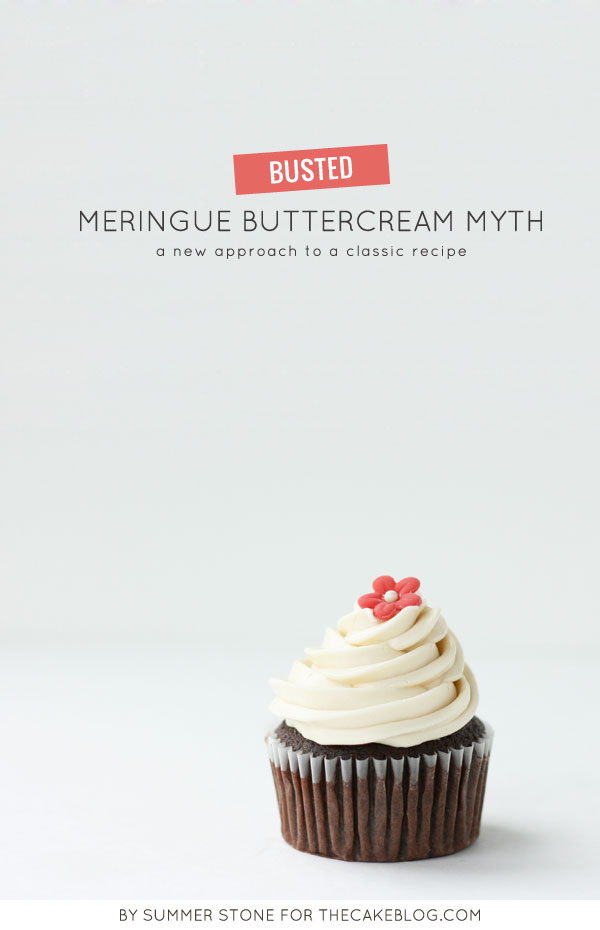
CAKE MYTH : You must create a meringue in order to produce a European-style buttercream.
For some time, I puzzled over the idea that you have to create a fully realized, stable meringue in order to make a Swiss Meringue Buttercream (SMBC). I wondered why one would create a beautifully peaked meringue and then destroy it by adding in loads of butter. I also wanted to know why SMBC’s were so inherently unstable and even the most practiced of bakers sometimes had difficulty making them behave. After much experimentation, I have found answers that will help you make buttercream faster and easier than ever before. You will find that you don’t need a meringue at all!
Here is my method for making Swiss Buttercream (SBC) and an explanation as to why it works:
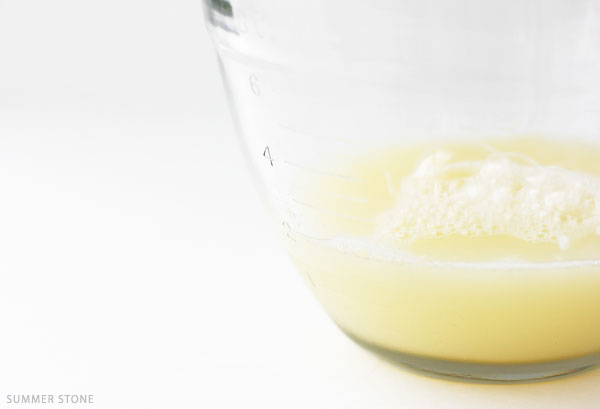
STEP 1 : Start with egg whites
Egg whites serve two important roles in SBC. They act as a structural component and serve as a liquid to dissolve granulated sugar into. In traditional SMBC, egg whites are beaten to peaks as a means of incorporating air into the buttercream. The problem with this is that protein mediated air pockets are very unstable in the presence of fat. When butter is added, much of the air which was beaten into the eggs is lost and it they become a syrupy puddle. Here I have used pasteurized egg whites from a carton, but separated egg whites from cracked eggs work just as well.
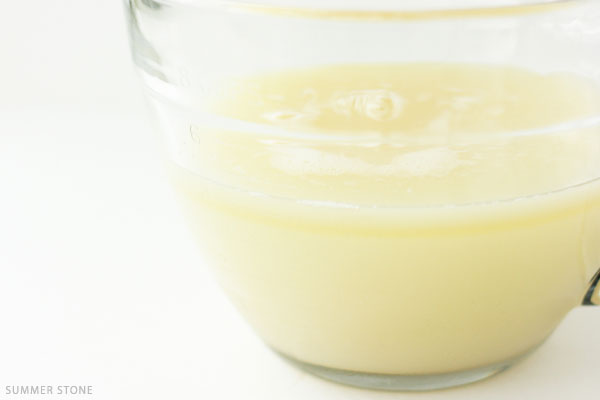
STEP 2 : Add sugar
Sugar obviously plays an important role as a flavor provider in a buttercream but it also serves to thicken and stabilize the egg liquid it is dissolved into. The sugar-egg combination, when mixed with butter, creates an emulsion that is more stable than either individual component.
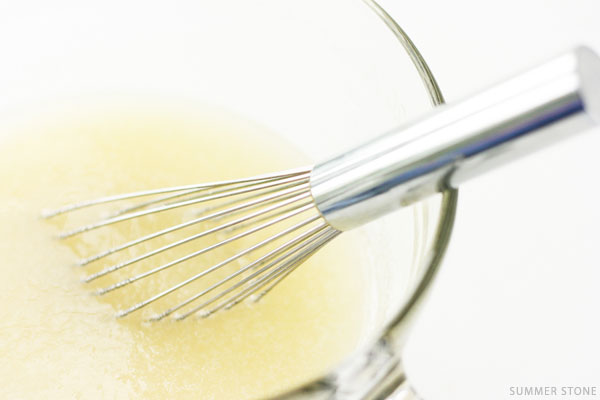
STEP 3 : Whisk the sugar and eggs together
The eggs and sugar have a symbiotic relationship. The eggs serve the sugar by providing a solvent into which it can be dissolved. At the same time, the sugar helps the egg whites by weakening their ability to coagulate allowing them to remain in a liquid state. Be sure to whisk the eggs and sugar together very well for maximum benefit. No one likes scrambled egg buttercream!
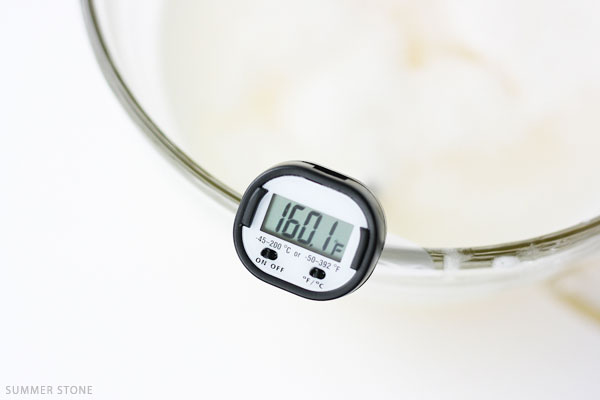
STEP 4 : Heat the eggs and sugar
While the egg whites are helpful in dissolving the sugar, at this high of a sugar concentration heat is required to fully dissolve the sugar crystals. Heat also functions to destroy any harmful bacteria that may be living in the egg whites (particularly if they are fresh). For this reason, you should heat your egg-sugar syrup to 160ᵒ F which will ensure Salmonella is killed. I find the easiest way to do this is in the microwave. One recipe will take 3-4 minutes stirring at one minute intervals. Alternatively you can heat the syrup in a double boiler until a safe temperature is reached. At 160ᵒ F all sugar crystals should be dissolved. I like to add a half ounce of corn syrup to the sugar-egg mixture to minimize the chances of recrystallization. Be sure to stir in any sugar granules than remain on the sides of the bowl. One undissolved rebel sugar crystal can reseed the whole batch.
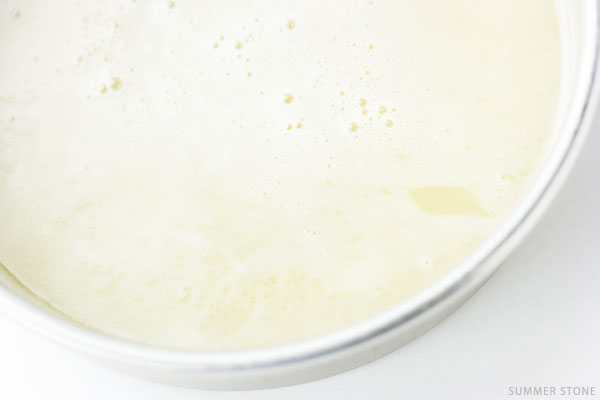
STEP 5 : Cool the egg-sugar syrup
I place my syrup in a clean cake pan and place it in the freezer for 20-30 minutes to reach a cool/cold temperature (45-60ᵒ F). When the sugar syrup is added to the butter in this temperature range, the two components generally go into emulsion seamlessly without “breaking”. This seems to be one of the problems with traditional SMBC. Since a meringue will not form readily in a cold syrup, the eggs and sugar would have to be at room temperature when the butter was added. This room-temperature blending stresses the combination and makes formation of a proper emulsion more difficult.
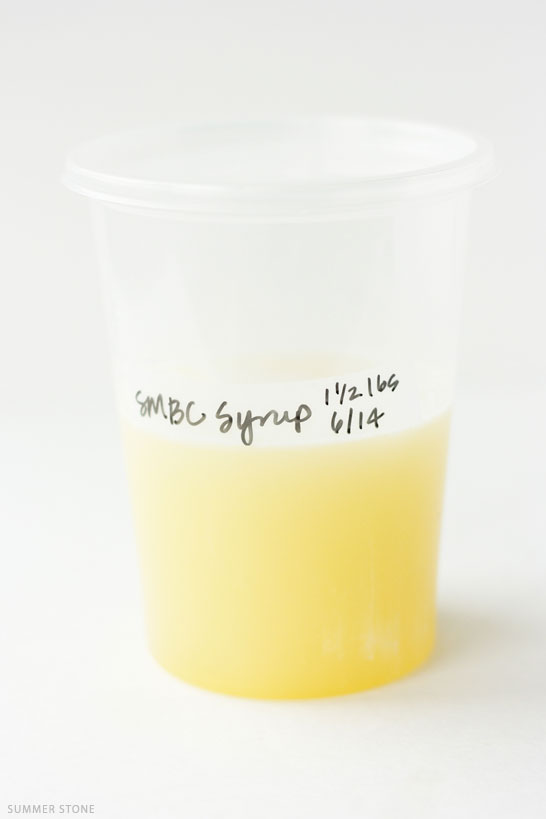
STEP 6 : Make extra syrup to save for later
One of the advantages of making SBC by this method is that you can make large batches of syrup and freeze the extra for quick and easy batches in the future. In the photos above, I made a double recipe of syrup and saved half for a future batch.
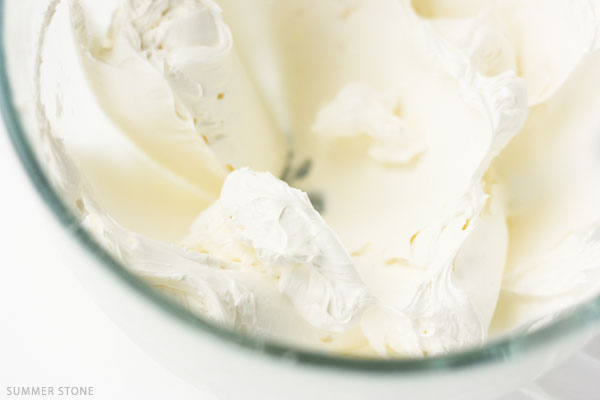
STEP 7 : Beat butter until light and fluffy
Butter is the all-star of SBC. It does the amazing emulsifying work. For this reason, it makes the most sense to start with the butter and add the cooled syrup to it. When the butter is beaten on high for 2 minutes before the syrup is added, it lightens the buttercream and takes in air in a way that is more structurally sound than that of beaten egg whites. I like to start with butter that is at a cool room temperature since it holds air better in a more solid form.
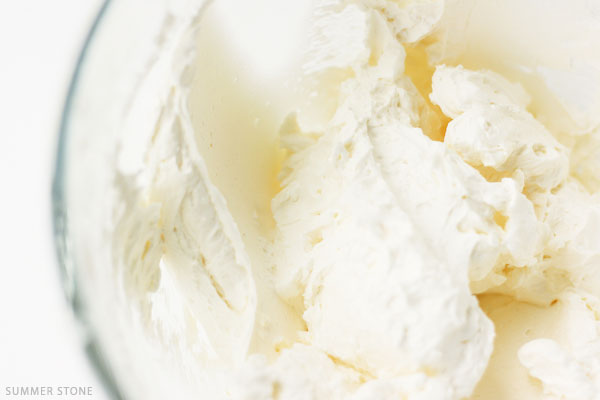
STEP 8 : Add half of the sugar syrup
Adding half of the liquid at a time allows the mechanical action of the mixer to work to develop the emulsion without overwhelming the butter and causing the mixture to break. Beat for one minute to fully incorporate the syrup before adding the final half.
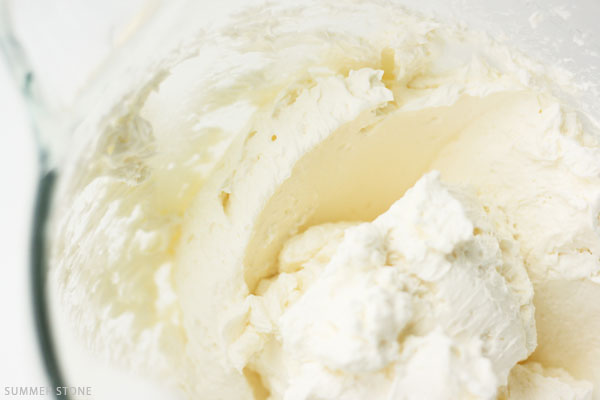
STEP 9 : Add remaining syrup
Add the second half of syrup to the butter mixture and beat on high to complete the emulsion and incorporate air into the mixture. The buttercream will be quite firm at this point.
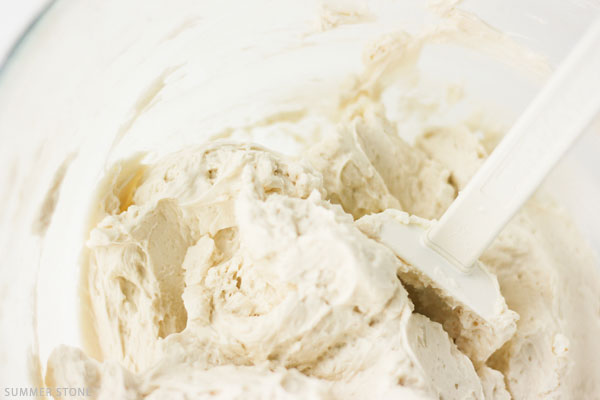
STEP 10 : Add vanilla and other flavorings
Adding liquids such as vanilla not only incorporates flavor but the liquids also smooth out and lighten the texture of the buttercream. At this point, the buttercream will be very firm and stable. If you would like a creamier buttercream that is less sweet, you can add additional butter, up to another 4 ounces. If you want a buttercream that is lighter in texture, more like whipped cream, you can add more liquid in the form of milk, sour cream, cream cheese, juice, alcohol, fruit purees or water. I have added up to a half a cup of cool water per recipe with success. Slowly drizzle in the additional liquid while the mixer is going on medium speed.
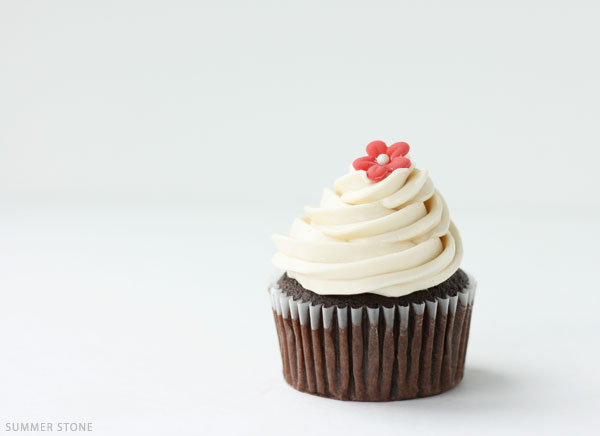
I hope you enjoy this alternate method for making a Europen-style buttercream and that you find it easier and more fool-proof than ever before! Happy baking!

SWISS BUTTERCREAM
a recipe by Summer Stone
- 8 ounces (227 grams) egg whites separated from whole eggs or from a carton- 1 cup
- 16 ounces (454 grams) granulated sugar- 2 ¼ cups
- ½ ounce (14 grams) corn syrup- 1 tablespoon
- 16 ounces (454 grams) unsalted butter softened but not warm- 2 cups
- 2 tablespoons (30 milliliters) vanilla extract
Whisk egg whites and sugar together in a microwave-safe bowl. Make sure the mixture is well mixed so the sugar can protect the eggs from cooking. Heat the mixture in the microwave for 2-4 minutes on high in 30 second intervals whisking well after each 30 second heating. Heat until the sugar is dissolved and the mixture reaches 160ᵒ F/72ᵒ C. (Alternatively this step can be carried out in a double boiler over simmering water). Pour the syrup into a cake pan or shallow metal bowl and chill in the freezer for 20-30 minutes until it is quite cool (45-60ᵒ F).
Meanwhile, beat the butter in a mixer for 2 minutes on high until the butter is lighter in color and aerated. Add the cooled syrup in two additions to the butter beating 1 minute after each addition. Add the vanilla and beat 30 seconds until smooth. Can be used immediately.
You can store this buttercream at room temperature for 2 days, in the refrigerator tightly sealed for 2 weeks, or in the freezer for 2 months.


I have used your technique and it worked perfectly I have several recipes for sugar free SMBC, using the traditional preparation method. Do you think that this would work with the xylitol instead of the sugar? I am having Easter dinner and plan to make a gluten free sugar free cake and wanted to make SMBC. If I test this recipe using the xylitol and send my results.
Does this color well?
One thing I don’t love about my traditional SMBC is air bubbles, which can be especially frustrating when trying to get perfectly smooth cakes. Do you find that this recipe is denser with less air because there is no whipping?
I am new to smbc and this method sounds very interesting. I have a small cupcake business that I operate from home and I am forever experimenting with new recipes. I have been baking for over 30 years and have always wanted to try smbc. Finally a couple of months ago I tried it for the first time using the recipe from Dorie Greenspan’s Perfect Party Cake which I followed to the letter. Well let me tell you it was the most divine icing I had ever made or eaten in my life! I am a convert. It was extremely stable and kept well for three days at room temperature. Everyone that tried it swooned over it. I had read that some people have a hard time with it but it worked perfectly for me and I’ve made it two more times since with the same results. I will definitely try your method to see what the difference is. Smbc in all its flavour variations has become my new obsession!
I just tried this recipe… the buttercream definitely works, but the texture doesn’t seem to be exactly the same. It seems more butter-like and doesn’t adhere as well as the traditional method. Any tips?
I tried this method but my mixture was just a gooey mess 🙁 I used the microwave method, checking every 30 secs and stirring it. Did this for 2 mins and checked temp at 160F. After chilling the eggwhite syrup I did notice there was a foam that formed on top, should I remove that before adding to the butter? I also wasnt able to ‘beat til airy’ my butter as room temp was quite warm in Manila, 38C and it was kinda melting in my mixer. Anyway I will try this on a much cooler day and any tips or insights on how I could’ve made this a succes would be much appreciated. Thanks!
Same issues here and I KNOW how to make great buttercream… not happy!
This recipe has worked super well for me. The butter can’t be too soft or it won’t work. Also the syrup can’t be too cold or it will look like it curdled. I have found that it works best if both the butter and syrup are around 60 to 65 degrees F (15 to 18 degrees C). If it is too cold and “curdles” you can keep beating until it gets warmer and it will eventually come together again.
As for the bubbles, i Just leave them in with no problems.
Will light corn syrup be okay?
Ok, let me be the first to say- I am NOT a baker! I have a huge interest appreciation and love for this particular art; however, I haven’t baked a cake in years. I tried this recipe yesterday on a round two layer white cake and WOW! It could not have turned out any more perfect! I will be using this recipe for life. So proud of this cake! I wish I could post a picture.
I love to bake and use the SBC because I don’t like the taste of powered sugar. Before this post, I dreaded how long it took me to make the frosting. I really LOVE this method. I thought it would be time consuming, but it wasn’t. I’m definitely a fan.
I do have two small questions: The frosting is a little too sweet for me. Can I reduce the amount of sugar? If so, will I need to adjust the amount of butter and egg whites.
Speaking of butter. My batch was a bit greasy. Wasn’t sure if I let my butter get too warm or if a pound of butter is too much? Any tips on reducing the greasy factor? Any idea of where I went wrong?
I’m having the same problem, I’m going to try not letting the butter get too warm and if that doesn’t quirk then I’ll try to reduce the butter.
Can the syrup be made a day or to ahead and refrigerated?
I just made this, I follow the instructions exactly and…. I LOVE IT!!!! my first time :)) I am sold!!! I have to bake a wedding cake soon, here in Arizona is too hot and I will use this recipe. The flavor is outstanding, even my husband like it ha! Thank you, thank you, thank you…
I found this via a link at Cakecentral and just tried it but after whisking every 30 seconds to bring it up to 160 degrees my sugar egg /mixture is a meringue and does not look like your photo.
Is it going to still work after it cools overnight in fridge?
I love the concept of this method and have tried this recipe a couple of times in the hopes of finding something less time consuming than my IMBC. Taste wise, both buttercreams are very similar, although this recipe is much sweeter than my IMBC. However, this buttercream is much more solid when compared to my IMBC, and it is also not as white. It simply does not have the lightness or luxurious quality of my IMBC, and while I agree that the IMBC/SMBC does deflate somewhat over time, it never develops the thick, butter-like quality of this buttercream. This method is great for emergency buttercream shortages and perhaps crumb coating for fondant, however, it’s too thick and buttery to be used as a primary filling.
Now THAT is what I wanted to know…Thanks!!
I’ve only ever made American buttercream and want to try to make a meringue buttercream. Does it crust over?
Hi,
This is the first time I’ve made any type of icing other than ABC or Cream Cheese Frosting. I just made the syrup (doubt you will see this in time to answer before I make the icing), but I wanted to know if I’m suppose t beat the butter with the paddle or whisk for my KitchenAid mixer. I checked the pictures but didn’t see which one you used. And do I use the same attachment when adding the syrup? Thanks!
Wow
This looks yummy and will try soon 🙂
Could you please tell us different flavours with quantities we can add to this batch of SBC?
Thanks!
Wow!! This recipe sound great. My stand mixer do not come with the paddle. Any alternative i could use to whip the SBC? Thank you!
Hi ms. Summer! Im looking forward to try this one! Im from the Philippines and our weather is always hot or humid i hope this buttercream can be stable… by the way have you tried using eggwhite powder to your buttercream? I hope you can also make some recipe out of it! And i’ll be looking forward to it! Thanks!
Hello! I am in the minority here but I want to know how much to INCREASE the sugar without ruining the integrity of the recipe. Any tips? Thanks!
Try adding some icing/confectioners sugar after the butter…
Tried this today as I’m a SMBC lover. Typically mine is adding cooled butter to the warm egg/sugar mix and it’s light, and fluffy, and yummy goodness. I tried this method, and was dissapointed. =( Though it was great tasting still, it wasn’t light and fluffy. It was very dense and I followed everything to a T. It’s way to dense/thick for the cake I needed it for. Hope to find another use for it as that was a good $15 worth of food to throw away
I’m in UK; also disappointed. Sickly sweet and dense and my biggest issue was keeping sugar crystals out of the mix while it cooled. I ended up with some real crunchy but useless smbc. Guess I’ll use it for practise piping or something. Back to my old and trusted method then; I’m all for experimentation and cutting production times but this one didn’t work for me and like you- I can’t afford to keep wasting ingredients. Nice try and great for those it works for.
will this one crust? Can I use Viva towel method to smooth it?
This is by far the best method I have ever tried. I have been on a mission to simplify the process and also questioned the standard practice in hundreds of baking books. This is a very sturdy/thick buttercream which is perfect for piping roses, there is a gorgeous sheen as well. You are a genius and I will never go back to the old-school way of making buttercream. Thank you!
Also to everyone who is stressing about paddles and other stand mixer attachments, no need to worry. I used a very old hand mixer and the buttercream turned out perfect.
OMG thank you for that information!!
I only have a hand mixer and I was stressing over the paddle attachment because EVERY recipe I read calls for it.
Thank you again!
Hello Summer Stone
Thank you for sharing this wonderful experiment. I’ve been able to make a super stable buttercream using this recipe a couple of times and really gives me best results. On the other hand, can this method be used for Egg yolks instead for a more stable French Buttercream?
You are amazing!! I cannot wait to try this! I haven’t read through all of comments, but if you wanted to make this a chocolate butter cream or another flavor would you also only add up to 4 oz? Thank you…I LOVE you Baking Science series…so enlightening. Happy Baking 😉
sorry for the typos…I was so excited I forgot to proofread!