We’re thrilled to welcome our newest contributor, Summer Stone of Cake Paper Party! Join along as Summer explores traditional baking concepts in new and exciting ways.
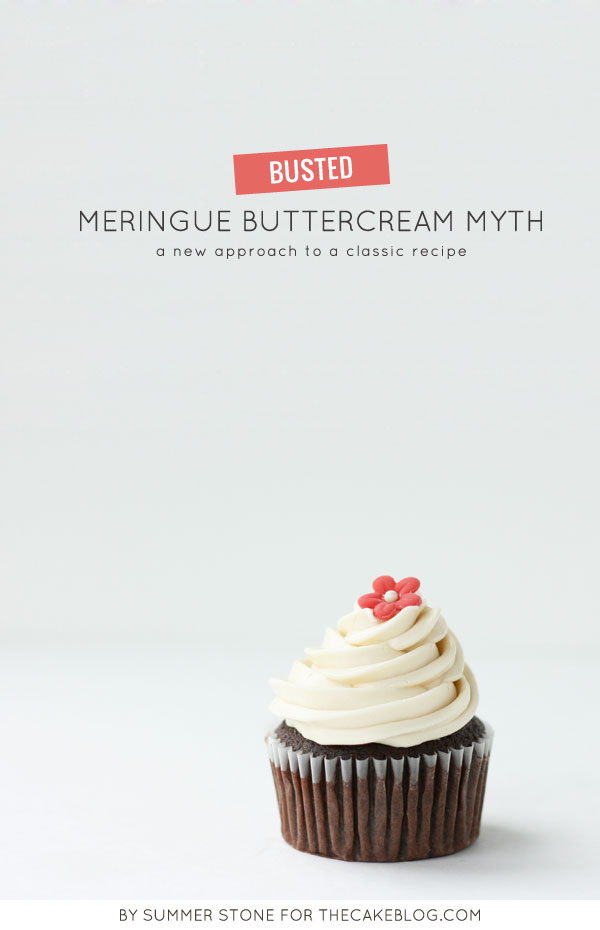
CAKE MYTH : You must create a meringue in order to produce a European-style buttercream.
For some time, I puzzled over the idea that you have to create a fully realized, stable meringue in order to make a Swiss Meringue Buttercream (SMBC). I wondered why one would create a beautifully peaked meringue and then destroy it by adding in loads of butter. I also wanted to know why SMBC’s were so inherently unstable and even the most practiced of bakers sometimes had difficulty making them behave. After much experimentation, I have found answers that will help you make buttercream faster and easier than ever before. You will find that you don’t need a meringue at all!
Here is my method for making Swiss Buttercream (SBC) and an explanation as to why it works:
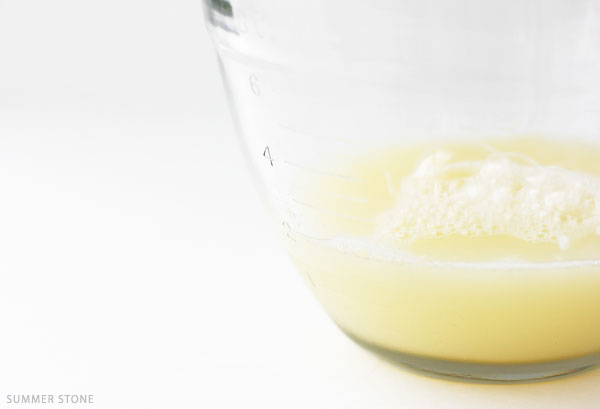
STEP 1 : Start with egg whites
Egg whites serve two important roles in SBC. They act as a structural component and serve as a liquid to dissolve granulated sugar into. In traditional SMBC, egg whites are beaten to peaks as a means of incorporating air into the buttercream. The problem with this is that protein mediated air pockets are very unstable in the presence of fat. When butter is added, much of the air which was beaten into the eggs is lost and it they become a syrupy puddle. Here I have used pasteurized egg whites from a carton, but separated egg whites from cracked eggs work just as well.
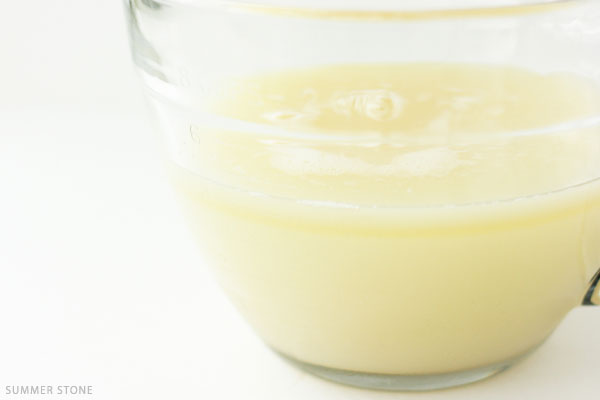
STEP 2 : Add sugar
Sugar obviously plays an important role as a flavor provider in a buttercream but it also serves to thicken and stabilize the egg liquid it is dissolved into. The sugar-egg combination, when mixed with butter, creates an emulsion that is more stable than either individual component.
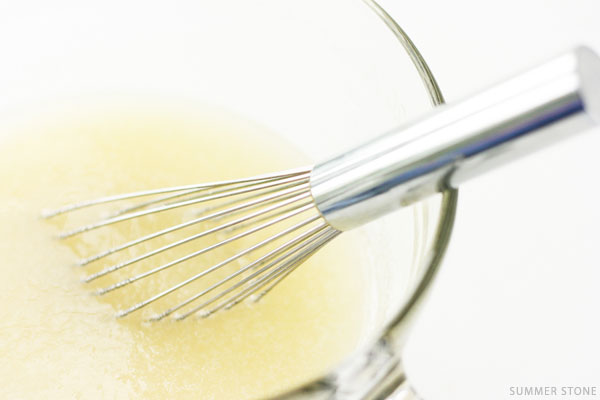
STEP 3 : Whisk the sugar and eggs together
The eggs and sugar have a symbiotic relationship. The eggs serve the sugar by providing a solvent into which it can be dissolved. At the same time, the sugar helps the egg whites by weakening their ability to coagulate allowing them to remain in a liquid state. Be sure to whisk the eggs and sugar together very well for maximum benefit. No one likes scrambled egg buttercream!
STEP 4 : Heat the eggs and sugar
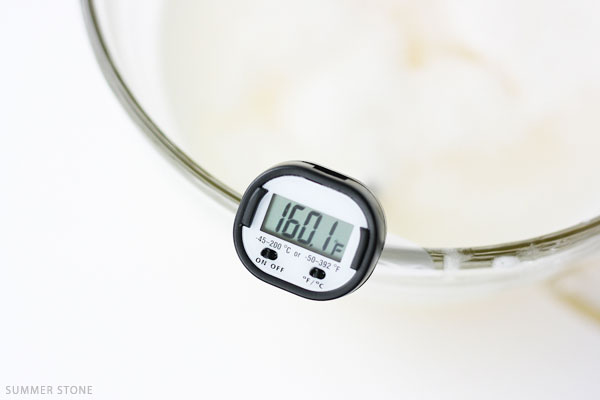
While the egg whites are helpful in dissolving the sugar, at this high of a sugar concentration heat is required to fully dissolve the sugar crystals. Heat also functions to destroy any harmful bacteria that may be living in the egg whites (particularly if they are fresh). For this reason, you should heat your egg-sugar syrup to 160ᵒ F which will ensure Salmonella is killed. I find the easiest way to do this is in the microwave. One recipe will take 3-4 minutes stirring at one minute intervals. Alternatively you can heat the syrup in a double boiler until a safe temperature is reached. At 160ᵒ F all sugar crystals should be dissolved. I like to add a half ounce of corn syrup to the sugar-egg mixture to minimize the chances of recrystallization. Be sure to stir in any sugar granules than remain on the sides of the bowl. One undissolved rebel sugar crystal can reseed the whole batch.
STEP 5 : Cool the egg-sugar syrup
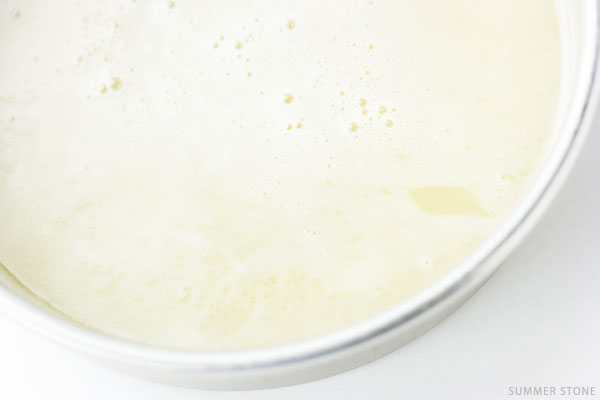
I place my syrup in a clean cake pan and place it in the freezer for 20-30 minutes to reach a cool/cold temperature (45-60ᵒ F). When the sugar syrup is added to the butter in this temperature range, the two components generally go into emulsion seamlessly without “breaking”. This seems to be one of the problems with traditional SMBC. Since a meringue will not form readily in a cold syrup, the eggs and sugar would have to be at room temperature when the butter was added. This room-temperature blending stresses the combination and makes formation of a proper emulsion more difficult.
STEP 6 : Make extra syrup to save for later
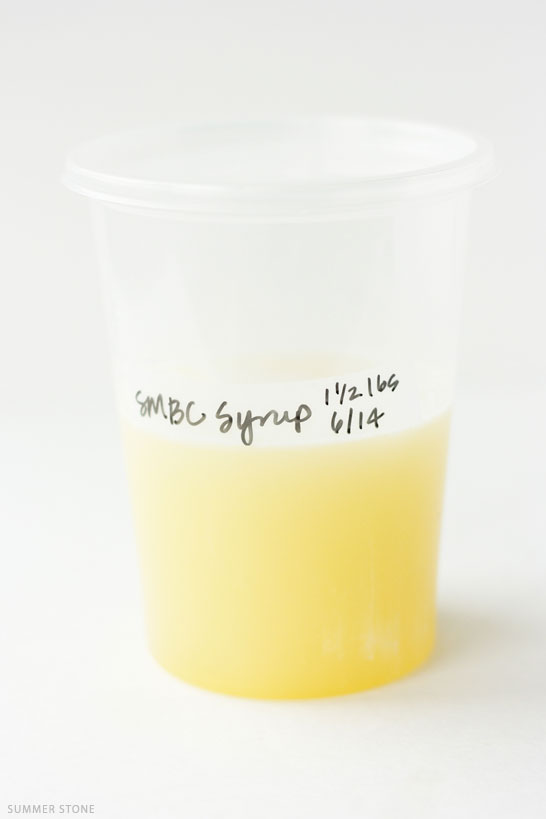
One of the advantages of making SBC by this method is that you can make large batches of syrup and freeze the extra for quick and easy batches in the future. In the photos above, I made a double recipe of syrup and saved half for a future batch.
STEP 7 : Beat butter until light and fluffy
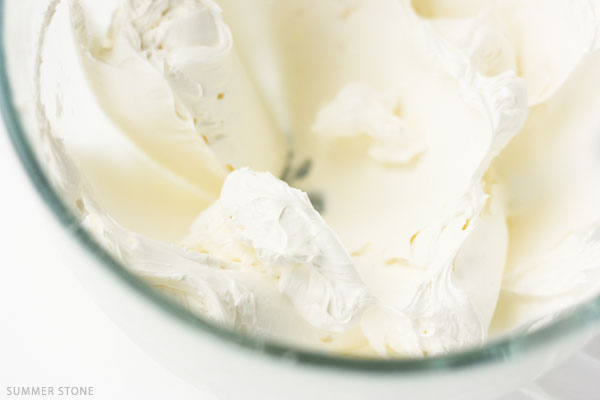
Butter is the all-star of SBC. It does the amazing emulsifying work. For this reason, it makes the most sense to start with the butter and add the cooled syrup to it. When the butter is beaten on high for 2 minutes before the syrup is added, it lightens the buttercream and takes in air in a way that is more structurally sound than that of beaten egg whites. I like to start with butter that is at a cool room temperature since it holds air better in a more solid form.
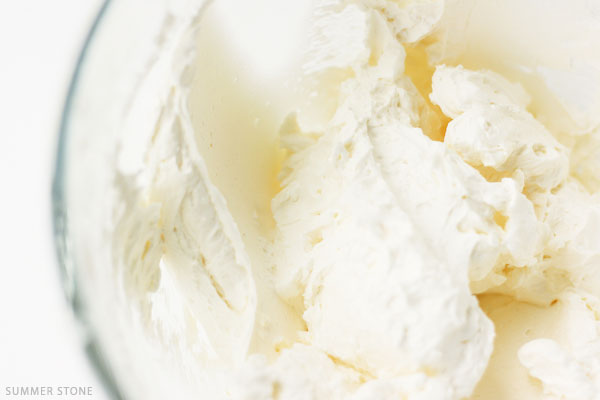
STEP 8 : Add half of the sugar syrup
Adding half of the liquid at a time allows the mechanical action of the mixer to work to develop the emulsion without overwhelming the butter and causing the mixture to break. Beat for one minute to fully incorporate the syrup before adding the final half.
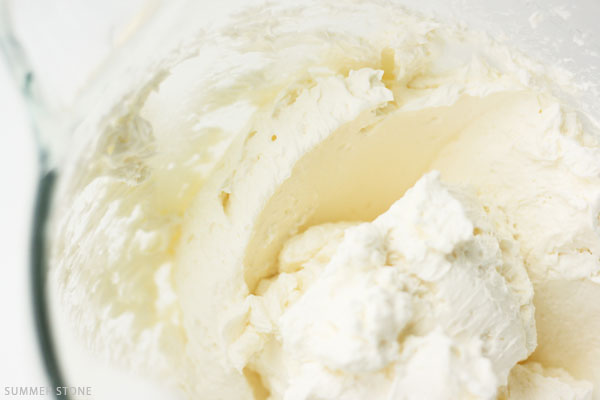
STEP 9 : Add remaining syrup
Add the second half of syrup to the butter mixture and beat on high to complete the emulsion and incorporate air into the mixture. The buttercream will be quite firm at this point.
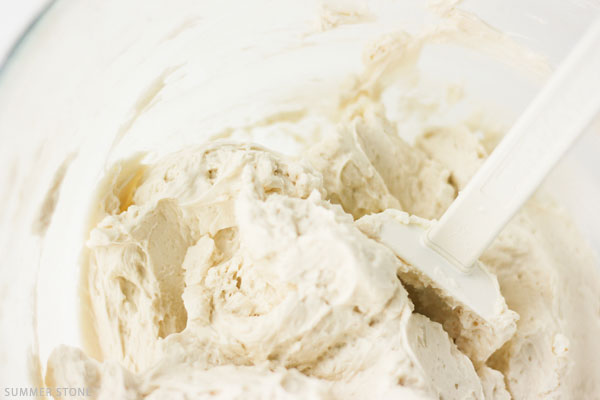
STEP 10 : Add vanilla and other flavorings
Adding liquids such as vanilla not only incorporates flavor but the liquids also smooth out and lighten the texture of the buttercream. At this point, the buttercream will be very firm and stable. If you would like a creamier buttercream that is less sweet, you can add additional butter, up to another 4 ounces. If you want a buttercream that is lighter in texture, more like whipped cream, you can add more liquid in the form of milk, sour cream, cream cheese, juice, alcohol, fruit purees or water. I have added up to a half a cup of cool water per recipe with success. Slowly drizzle in the additional liquid while the mixer is going on medium speed.
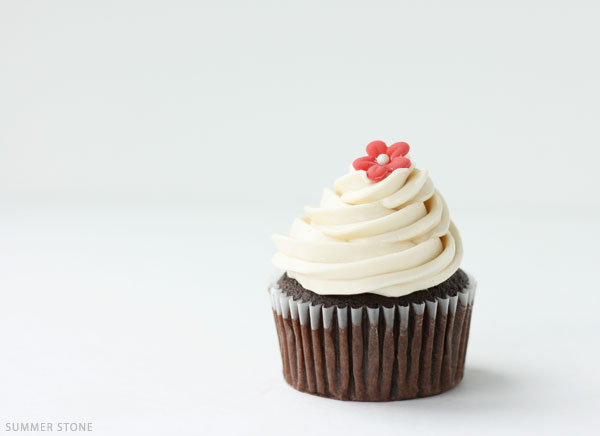
I hope you enjoy this alternate method for making a Europen-style buttercream and that you find it easier and more fool-proof than ever before! Happy baking!

SWISS BUTTERCREAM
a recipe by Summer Stone
- 8 ounces (227 grams) egg whites separated from whole eggs or from a carton- 1 cup
- 16 ounces (454 grams) granulated sugar- 2 ¼ cups
- ½ ounce (14 grams) corn syrup- 1 tablespoon
- 16 ounces (454 grams) unsalted butter softened but not warm- 2 cups
- 2 tablespoons (30 milliliters) vanilla extract
Whisk egg whites and sugar together in a microwave-safe bowl. Make sure the mixture is well mixed so the sugar can protect the eggs from cooking. Heat the mixture in the microwave for 2-4 minutes on high in 30 second intervals whisking well after each 30 second heating. Heat until the sugar is dissolved and the mixture reaches 160ᵒ F/72ᵒ C. (Alternatively this step can be carried out in a double boiler over simmering water). Pour the syrup into a cake pan or shallow metal bowl and chill in the freezer for 20-30 minutes until it is quite cool (45-60ᵒ F).
Meanwhile, beat the butter in a mixer for 2 minutes on high until the butter is lighter in color and aerated. Add the cooled syrup in two additions to the butter beating 1 minute after each addition. Add the vanilla and beat 30 seconds until smooth. Can be used immediately.
You can store this buttercream at room temperature for 2 days, in the refrigerator tightly sealed for 2 weeks, or in the freezer for 2 months.


Do you think I could substitute some shortening for the some of the butter? I need a whiter color.
Can this be made dairy free? I’m thinking maybe a mix of shortening and margarine might work, any thoughts?
Hi Summer,
I have never made smbc. I want to try this. Small clarification- how do I make coffee flavor with this buttercream?
Thanks for the very informative instructions given.
Happy baking 😊😊
About to try this recipe. First time making this type of buttercream. I’ve been looking for a buttercream that isn’t too sweet yet creamy and relatively stable in warm temps. My search led me here. Fingers crossed
Summer, thank you for your recipe! I used your method for the first time in 2014 and have made it that way ever since. This year, I learned how to make French buttercream, which just uses egg yolks. It got me thinking about SMBC, so I reread your recipe and the reasoning behind it, and wondered if I could make the syrup with whole eggs. I tried it and it worked! It was light and fluffy like SMBC, but with the added richness of the egg yolk. For someone who isn’t the best at separating eggs, it was a revelation! I wouldn’t suggest using whole eggs if you want a beautiful white buttercream, but if you’re tinting it or adding purees or chocolate, it works perfectly.
Does this recipe work without the ‘corn syrup’?
Hi, I’d like to try this but I have a few questions. 1. Can this be used in between layers of cake? Crumb coating? And then piping flowers?
2. Can you add flavours to it? like chocolate, nutella etc.? When to put flavours if so? Would if affect the consistency?
3. Can you over beat this and get ruined? Is there any way to recover from over beating if so?
I apologise for too much questions I have.
Why my buttercream turned out to be very wet? What do you think went wrong? Do you know how to recover it? 🙁 Thanks?
I’m wondering if you have any thoughts on cutting back on the sugar and adding some dulce de leche caramel…maybe 1/2 less sugar and 1/2 cup caramel…to make it caramel flavored? Or, do I need to keep the weight/measurement of the egg whites and sugar the same/equal? I don’t want this to be overly sweet, so I’m concerned about just adding the caramel. Maybe if I add a bit of whipping cream it will help cut the sweetness. Oh, what to do? Smiles!! Thanks for any input.
Made 3 batches of this. 1st time 11 yo daughter did it without me, didn’t cool long enough and ended up with soup. Wickedly delicious, sad soup. She threw it out. Second time we made it together and it got too cold, didn’t emulsify, but a little time over hot water until it was melty on the edges and then a good whip fixed it. We made Batch 3 because so much of batch 2 got eaten straight out of the fridge by the spoonful.
FYI we had better success using the whisk attachment than using the paddle attachment.
Hi! Thank you for this recipe. I just started making SMBC and I use way less sugar in the traditional recipe (150g whites, 125g sugar, 285g butter)
Do you think I can use the same recipe for this method or does that mess with the science of it?
That ratio of sugar is the perfect sweetness we prefer.
TIA!
Hi Summer. This blog was quite some time ago. I hope you still reply to messages.
How do you achieve bright, even colours using this SBC? Thanks in advance.
Hi Summer,
Thanks a lot for this.
I wonder if you could comment on the science behind the butter ratio and its impact on stability.
What happens if we double the butter in this recipe?
I’ve seen recipes which calls for upwards of 700g with about 210g of egg whites.
Thank you
Bee